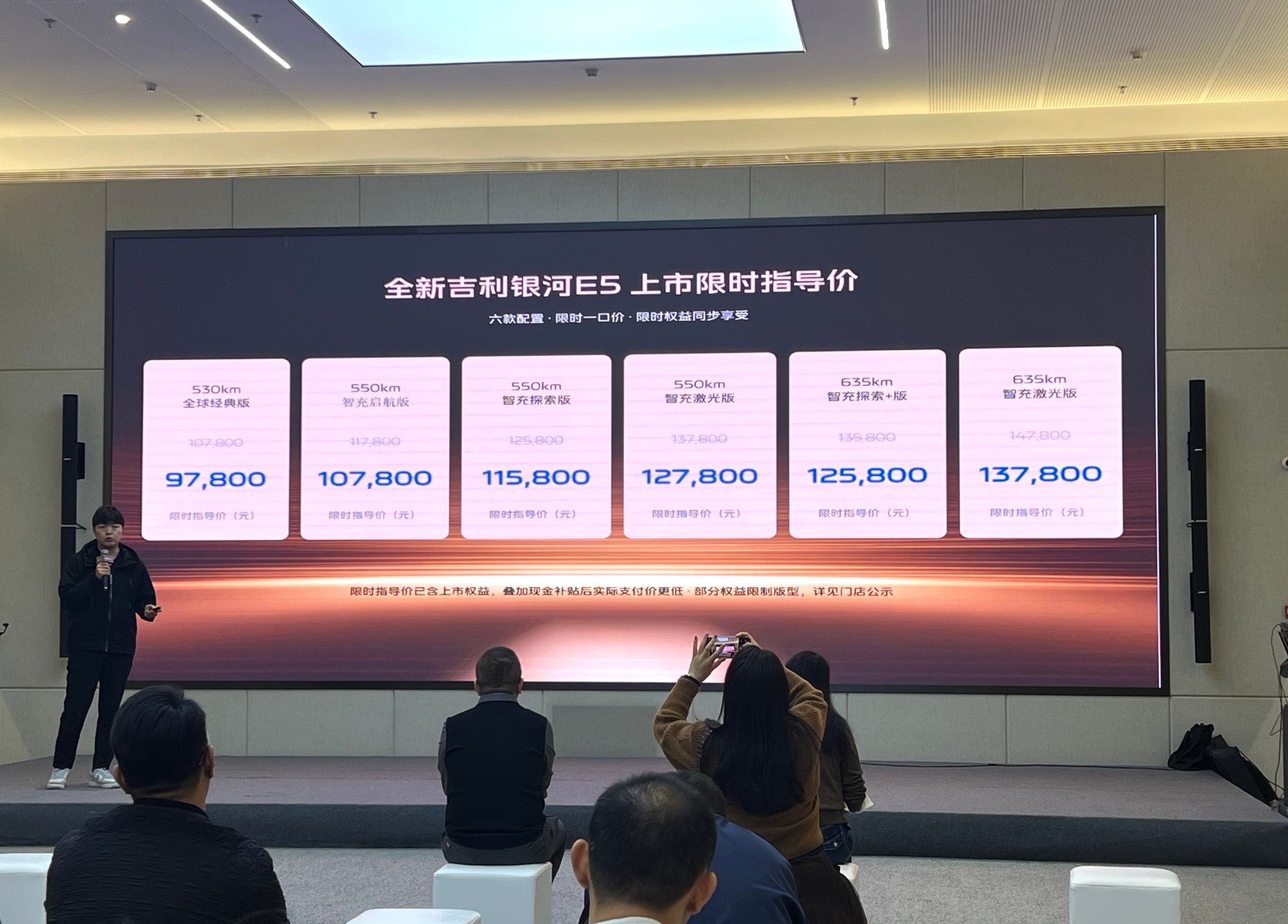
With a budget of around 100,000 yuan, you want to buy a new energy vehicle that both looks good and is fun to drive—honestly, there are quite a few models like that, and the Geely Galaxy E5 is one of them.
As one of the Geely Galaxy lineup members, the E5 model also recently received a refresh, significantly boosting its market competitiveness.
Front-wheel drive has become rear-wheel drive for better handling, and it is equipped with lidar, the Qianli Haohan H5 advanced driver assistance system, 6C ultra-fast charging and the new-generation Aegis Short Blade battery for faster charging.
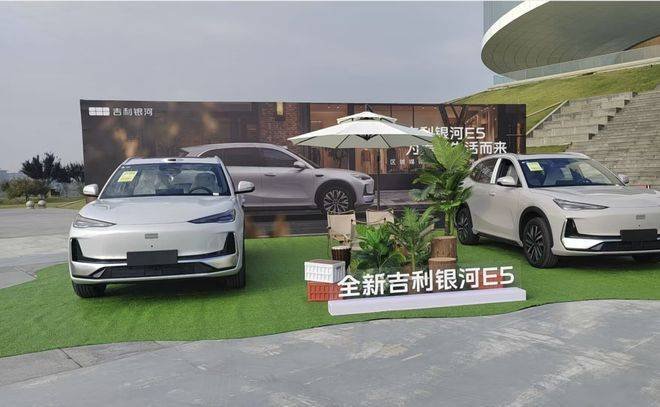
Exterior: good-looking and timeless
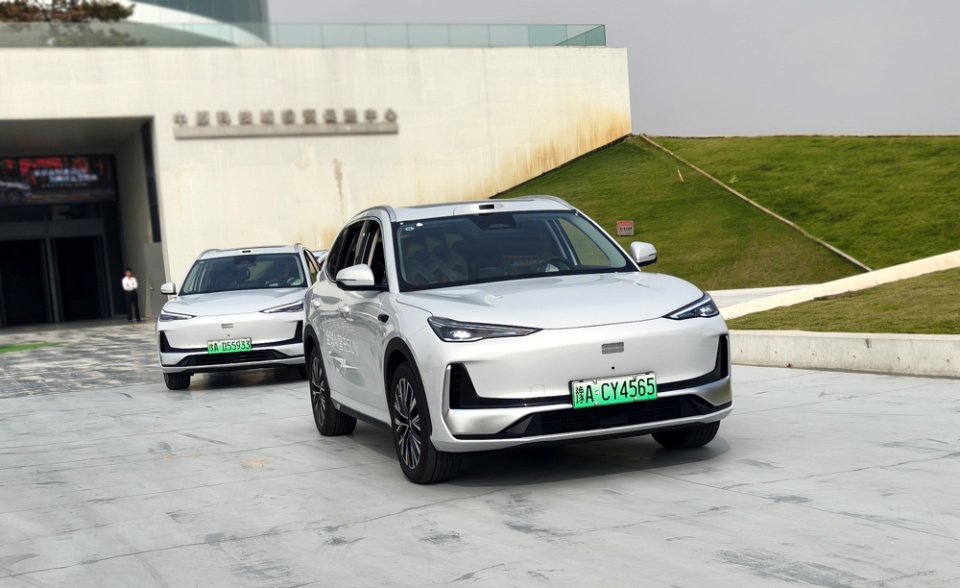
The overall styling is fairly fashionable. The front face adopts the closed-off design common to new energy vehicles, and with the "flying eaves and tiger gaze" LED headlights, air guide grooves and air intake, it presents a strong visual aesthetic; the front bumper adds matte chrome elements, and together with the slightly shovel-shaped front lip, it gives a bit more sportiness than the old model. The clean rear end echoes the "rising sun" full-width taillights, with clearly visible layering.
There are several details worth mentioning: this generation has switched the hidden door handles back to traditional pull-type handles—for winter use in the north, this is actually a more pragmatic choice, avoiding the awkward situation of frozen door handles; the second-row windows are equipped with privacy glass; a camera has been added to the fender, lidar is added to the roof, and a camera is also installed at the top of the rear, supporting visual recognition power tailgate—when carrying things, just extend a foot and the trunk opens.
In terms of body dimensions, the all-new Galaxy E5 measures 4636/1920/1670mm in length, width and height, with a wheelbase of 2750mm, placing it in the standard compact SUV size class.
Space: a sense of practicality that punches above its class
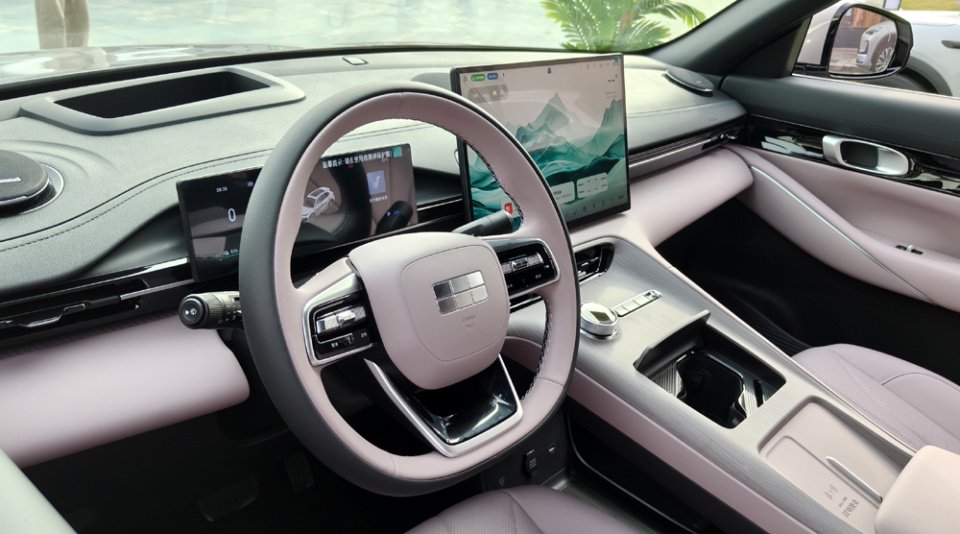
The neatly laid-out interior looks simple but is not simplistic: a wraparound cockpit, extensive soft-material wrapping, and the door panels and armrests all feel good to the touch. The 15.4-inch 2.5K floating central control screen is the visual center, paired with a 10.2-inch full LCD instrument cluster, and the "crystal diamond flowing light" rotary knob also has a quality feel, without any cheapness.
The rear row is the core for family use. I am 1.78m tall and can get two fists of legroom and one fist of headroom; the backrest angle is relaxed and the seat cushion is soft, so sitting for long periods is not uncomfortable; the floor is completely flat, so the middle passenger also has somewhere to put their feet. Even more thoughtful is that hidden storage drawers are built under the rear seats, making it convenient to store small items such as shoe covers, umbrellas and children's snacks.
Storage capacity is equally outstanding. The whole vehicle has 33 storage spaces of various sizes; the new model also adds a 160L front trunk compared with the old model, with drainage holes and knock-to-unlock support—for charging guns, camping gear, and as an angler, I can only say the front trunk is truly thoughtful; the trunk has a regular volume of 461L, expandable to 1877L when the rear seats are folded down, so strollers and camping gear are no problem at all.
Driving dynamics: a rear-drive that is fun to drive
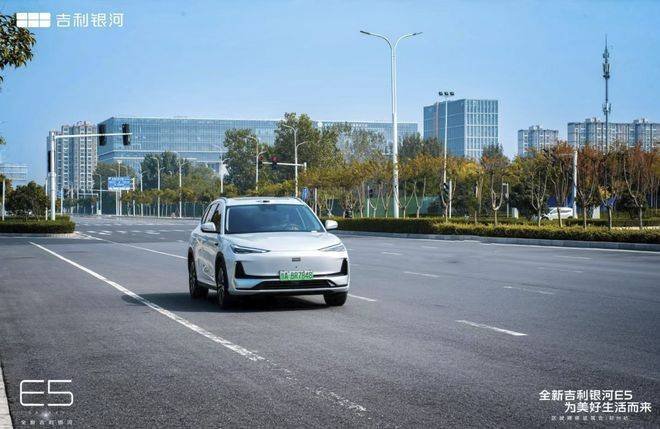
The biggest change in this refresh is that the drive type has changed from the old model's front-wheel drive to rear-wheel drive. It adopts single-motor drive, with total motor power of 160kW and 245kW respectively, and a maximum CLTC pure electric range of up to 635 kilometers.
First, the real hands-on impression. In Comfort mode, the power is very smooth and the start is not jumpy, suitable for city commuting; when you want to accelerate to overtake, it is also very brisk—press the accelerator pedal slightly and an obvious pushback sensation follows. The advantages of rear-wheel drive are obvious: when cornering there is none of the front-drive push-understeer feel, steering play is not large, and it drives very nimbly; the steering feel is generally on the light side, so even female drivers feel no pressure, and the turning radius is small, so U-turns at city intersections can basically be done in one go.
The chassis uses front MacPherson and rear five-link independent suspension, and the high trim also comes with CCD intelligent variable damping suspension. When passing speed bumps, the vibration filtering is gentle; on rough roads it softens to absorb shocks, and in corners it stiffens to support the body; braking does not nod and starting does not jerk, and the moose test result reaches 81km/h, which is a ceiling-level figure in its class. While driving, whether over speed bumps or gravel roads, the road feel is relatively clear, and occupants basically do not feel subtle bumps.
One thing to mention: if regenerative braking is set to the standard level, releasing the accelerator will produce a fairly obvious drag sensation, which takes a little time to get used to.
Intelligence: Qianli Haohan H5
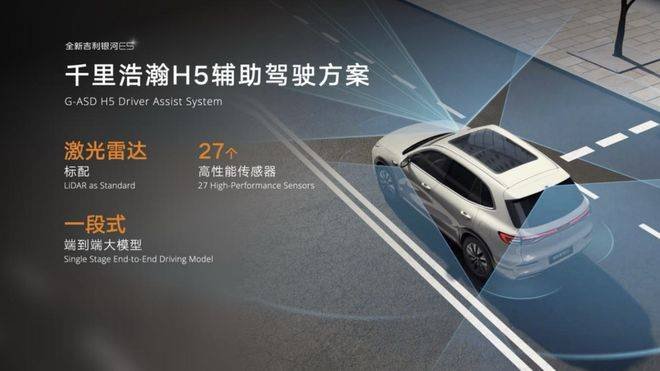
The all-new Galaxy E5 lidar version is equipped with the Qianli Haohan H5 advanced driver assistance system, adopting a lidar solution, with 27 high-performance sensors throughout the vehicle, combined with an end-to-end large model on the vehicle side. It can not only achieve L2-level assisted driving, but also supports highway NOA and urban NOA navigation, covering 19 major high-frequency complex scenarios such as roundabout passage, large vehicle avoidance and U-turns, as well as functions such as lane change assist, remote parking and high-speed navigation.
Parking is also above its class: the parking system covers 300+ parking spaces, with a one-shot parking success rate of 70%, and supports exit-and-park, fingertip parking and cross-floor memory parking, while automatically finding a space in underground garages is no problem either.
In terms of safety configuration, the all-new Galaxy E5 comes standard with sentry mode, rollover prevention, hill descent control, 360-degree panoramic camera, transparent chassis and cruise control; high trim models also add fatigue driving alerts, suspension soft/hard adjustment, full-speed adaptive cruise, 12 ultrasonic radars and 1 lidar, among others.
Energy replenishment: 6C ultra-fast charging + 800V
As a "global AI smart charging SUV," the all-new Galaxy E5 is equally uncompromising when it comes to replenishing energy. The entire lineup is equipped with a full-domain 800V high-voltage platform, with a peak charging rate of 6C and a peak charging power of up to 460kW; combined with the 370mm Aegis Golden Brick ultra-short blade battery, it takes only 8 minutes and 25 seconds to charge from 10% to 70% at room temperature, truly achieving "charge for 8 minutes, commute for a week."
The new-generation Aegis Short Blade battery is also hardcore in terms of safety: among the 24 safety tests in the new national standard, 23 were completed beyond the standard, and Geely additionally added 12 exclusive stringent standards; the cycle life is 3,500 cycles, equivalent to more than one million kilometers of driving, one generation of battery for two generations of cars. In addition, the new car also supports high-voltage fast charging and external discharge functions.
Final thoughts
Back to the original question: in the 100,000-150,000 yuan budget range, if you want to buy a good-looking and fun-to-drive new energy vehicle, is the all-new Galaxy E5 worth it?
My answer is yes. It may not be the one with the most explosive specs, but it firmly meets these family essentials: "good-looking, fun to drive, easy to load, smart enough, and fast to recharge." Among 100,000-yuan-class pure electric SUVs, whether in terms of cost-effectiveness, driver assistance, materials or range, the all-new Galaxy E5 has notable advantages and is a model worth recommending.


