The traditional off-season still displayed the characteristics of an off-season.
On August 11, the China Association of Automobile Manufacturers (hereinafter referred to as CAAM) released the automobile market data for July. Overall, in July, under the influence of factors such as the traditional off-season and annual equipment maintenance at some manufacturers, the pace of automobile production and sales slowed somewhat, showing a seasonal month-on-month decline.
At the same time, however, the trade-in policy continued to exert its effect, "positive progress was made in the industry-wide comprehensive campaign against 'involution,'" consumer confidence in automobile consumption continued to be boosted, "ensuring the stable operation of the industry in the second half of the year."
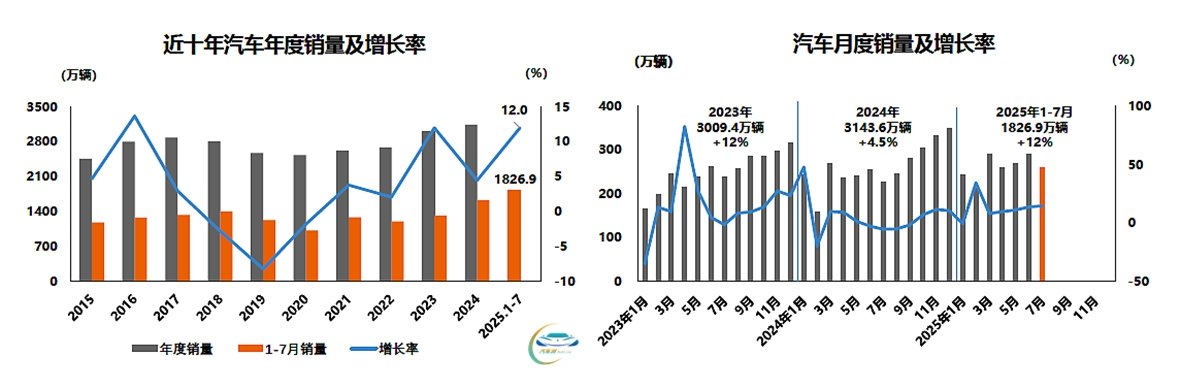
CAAM data shows: in July, automobile production and sales reached 2.591 million and 2.593 million units respectively, down 7.3% and 10.7% month-on-month, but up 13.3% and 14.7% year-on-year. From January to July, automobile production and sales reached 18.235 million and 18.269 million units respectively, up 12.7% and 12% year-on-year, with the growth rates expanding by 0.2 and 0.6 percentage points respectively compared with the first six months.
So the off-season is reflected in the month-on-month data, but year-on-year growth remains in double digits.
On the other hand, domestic sales of traditional fuel vehicles have also maintained growth for two consecutive months: in July, domestic sales of traditional fuel vehicles were 981,000 units, down 17.4% month-on-month, but up 8.4% year-on-year — so from the consumer perspective, mainstream consumption is still oscillating between traditional fuel and new energy models.
In July, domestic automobile sales were 2.018 million units, down 12.7% month-on-month and up 12.6% year-on-year. From January to July, domestic sales already exceeded 14.588 million units, up 11.8% year-on-year. So this year's market performance is clearly higher than that of 2024, and the growth rate is also quite remarkable.
According to Baidu search data, in the first six months of 2025, global automobile sales were 46.32 million units, of which new energy vehicles accounted for only 21.4%. Comparing the global data with CAAM data: China's cumulative automobile sales have exceeded one quarter of the global total, and the increase in the market share of new energy vehicles is also largely attributable to the growth in China's new energy vehicle consumption.
So without comparison, one cannot appreciate the extent of China's automobile industry's efforts, nor can one form a clear concept of the world's largest automobile market.
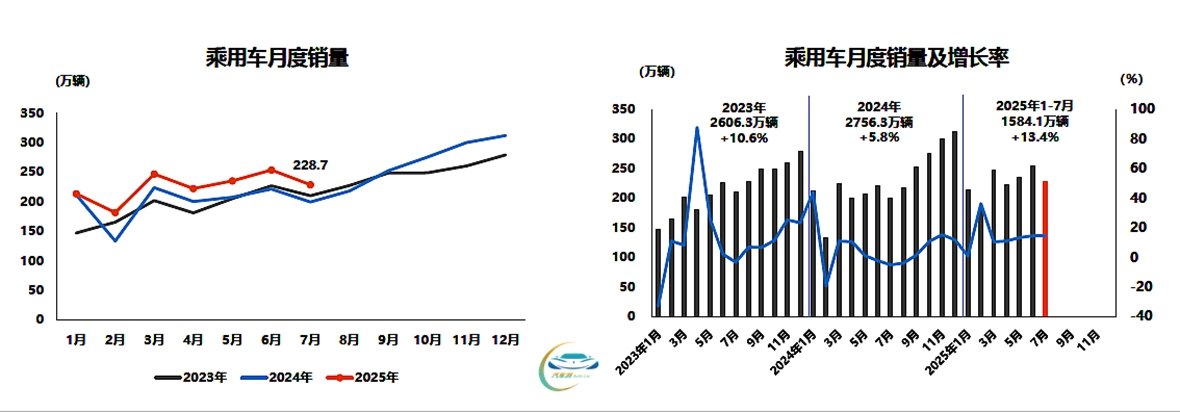
Back to the main point, among the two major branches of the automobile market, passenger vehicles have a very obvious impact on the overall data: in July, passenger vehicle production and sales reached 2.293 million and 2.287 million units respectively, down 6% and 9.8% month-on-month, but up 13% and 14.7% year-on-year. From January to July, passenger vehicle production and sales reached 15.838 million and 15.841 million units respectively, up 13.8% and 13.4% year-on-year.
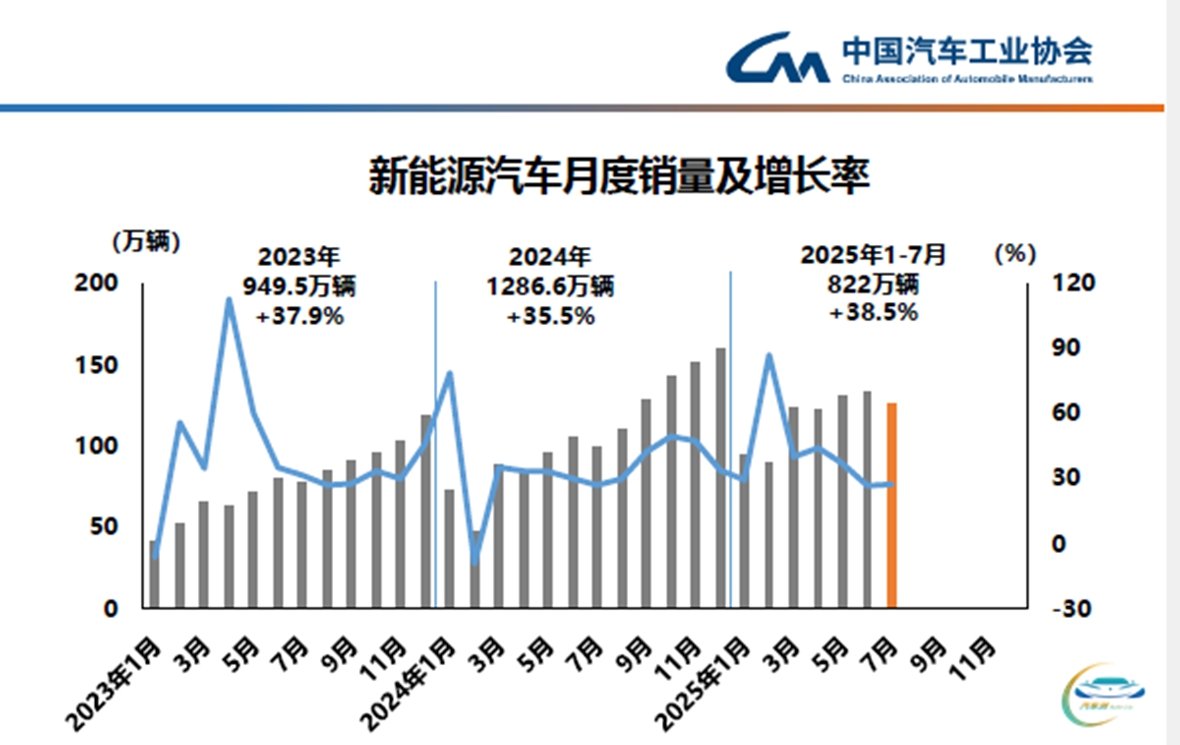
As just mentioned, mainstream consumers are still oscillating between traditional fuel vehicles and new energy vehicles. This is also true from the production and sales data of new energy vehicles. CAAM data shows: in July, new energy vehicle production and sales reached 1.243 million and 1.262 million units respectively, up 26.3% and 27.4% year-on-year, with new energy vehicle sales accounting for 48.7% of total new vehicle sales.
From January to July, new energy vehicle production and sales reached 8.232 million and 8.22 million units respectively, up 39.2% and 38.5% year-on-year, with new energy vehicles accounting for 45% of new vehicles.
50% is almost a threshold for new energy vehicles. From the explosive growth of new energy vehicles in the past two years to now, they have consistently hovered around 50%, but as of now have still not been able to break through the halfway mark.
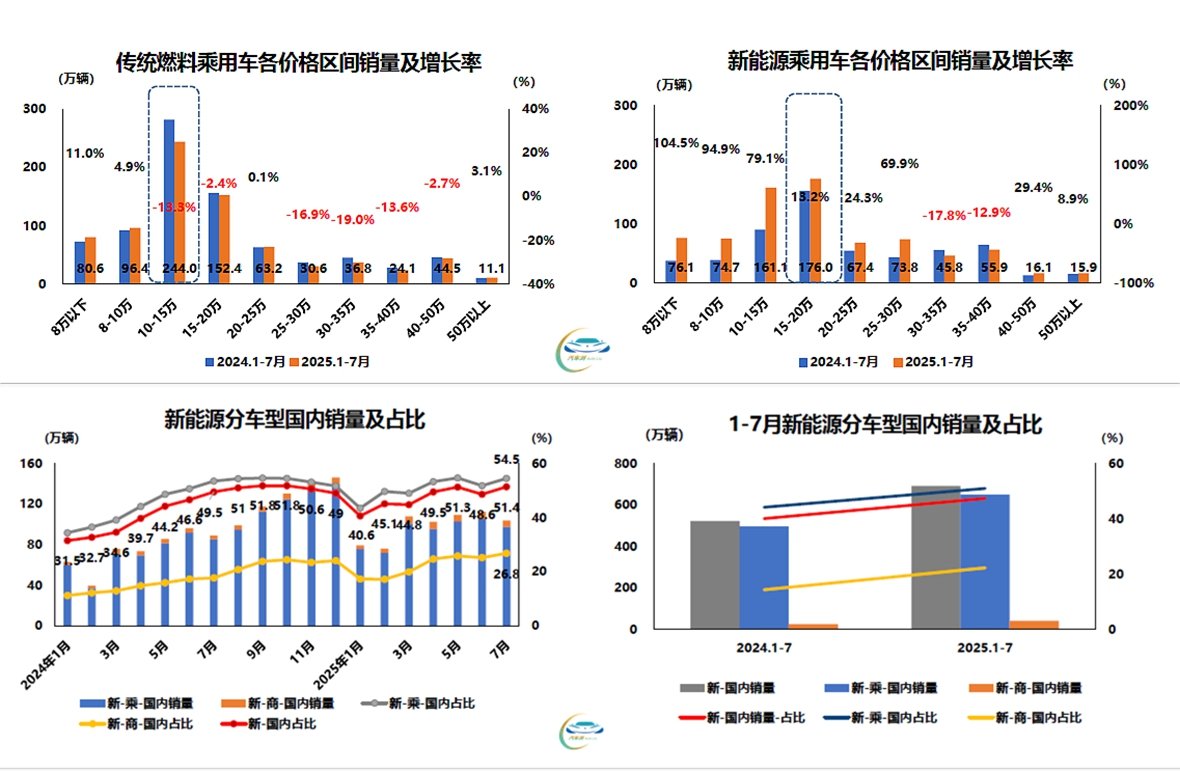
Breaking down the new energy market further, battery electric vehicles still account for the main share, with July sales of 811,000 units, up 47.1% year-on-year, while plug-in hybrid vehicle sales were 451,000 units, up 2.8% year-on-year. In terms of cumulative data, from January to July, cumulative sales of battery electric vehicles were 5.246 million units, up 46.9% year-on-year, and cumulative sales of plug-in hybrid vehicles were 2.972 million units, up 25.9% year-on-year.
Sales of new energy passenger vehicles by segment also show new changes: from January to July, new energy passenger vehicle sales were mainly concentrated in the A and B segments, with cumulative sales of 2.265 million and 2.017 million units respectively, up 22.2% and 10.2% year-on-year, and "A0 and A00 segments maintained a high-speed growth trend driven by policies."
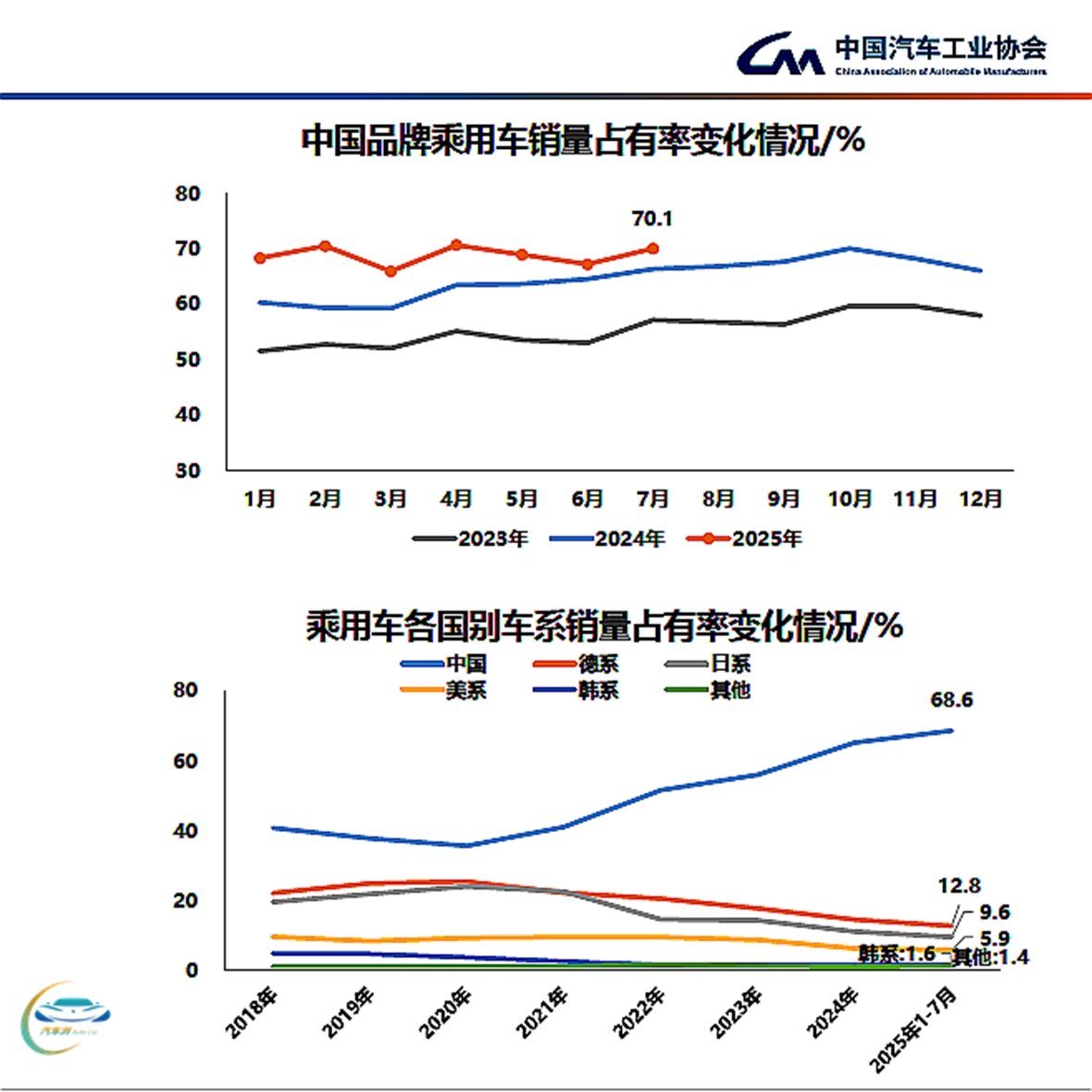
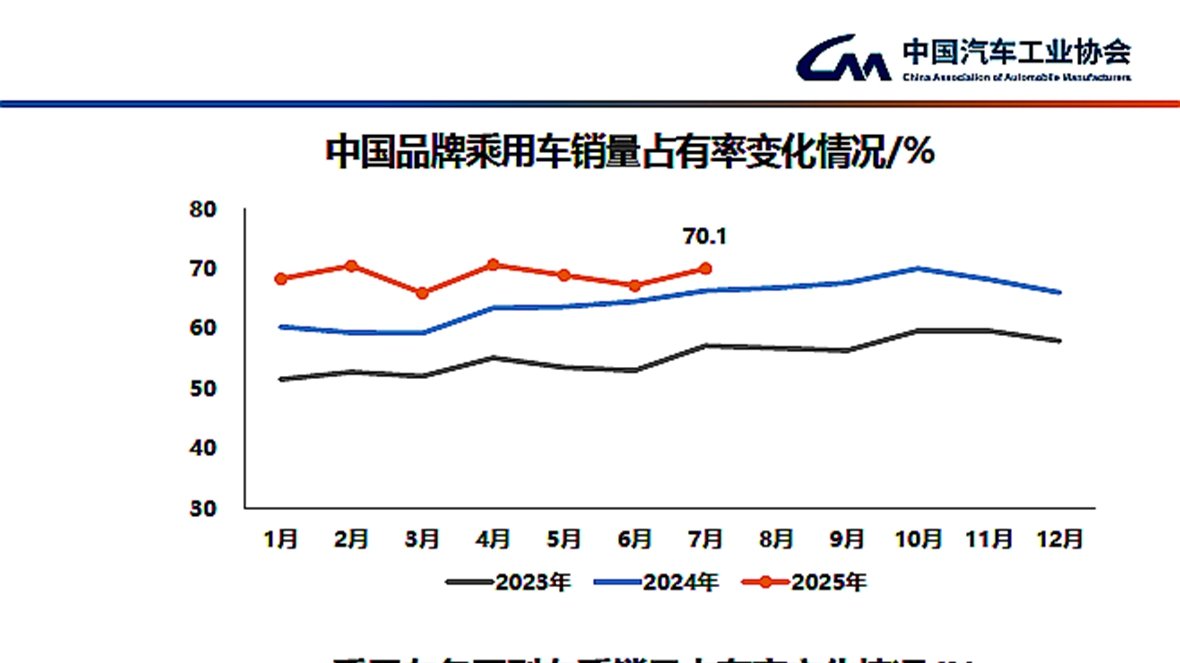
Domestic consumers' confidence in Chinese-brand passenger vehicles is also growing. CAAM data shows: in July, sales of Chinese-brand passenger vehicles were 1.604 million units, up 21.3% year-on-year, with a market share of 70.1%, up 3.8 percentage points from the same period last year. From January to July, total sales of Chinese-brand passenger vehicles reached 10.873 million units, up 24.4% year-on-year, with a market share of 68.6%, up 6.1 percentage points year-on-year.
While domestic sales grow, China's passenger vehicle exports also continue to maintain growth momentum.
In July, passenger vehicle exports were 499,000 units, down 0.5% month-on-month but up 25.2% year-on-year. From January to July, passenger vehicle exports were 3.103 million units, up 13.3% year-on-year.
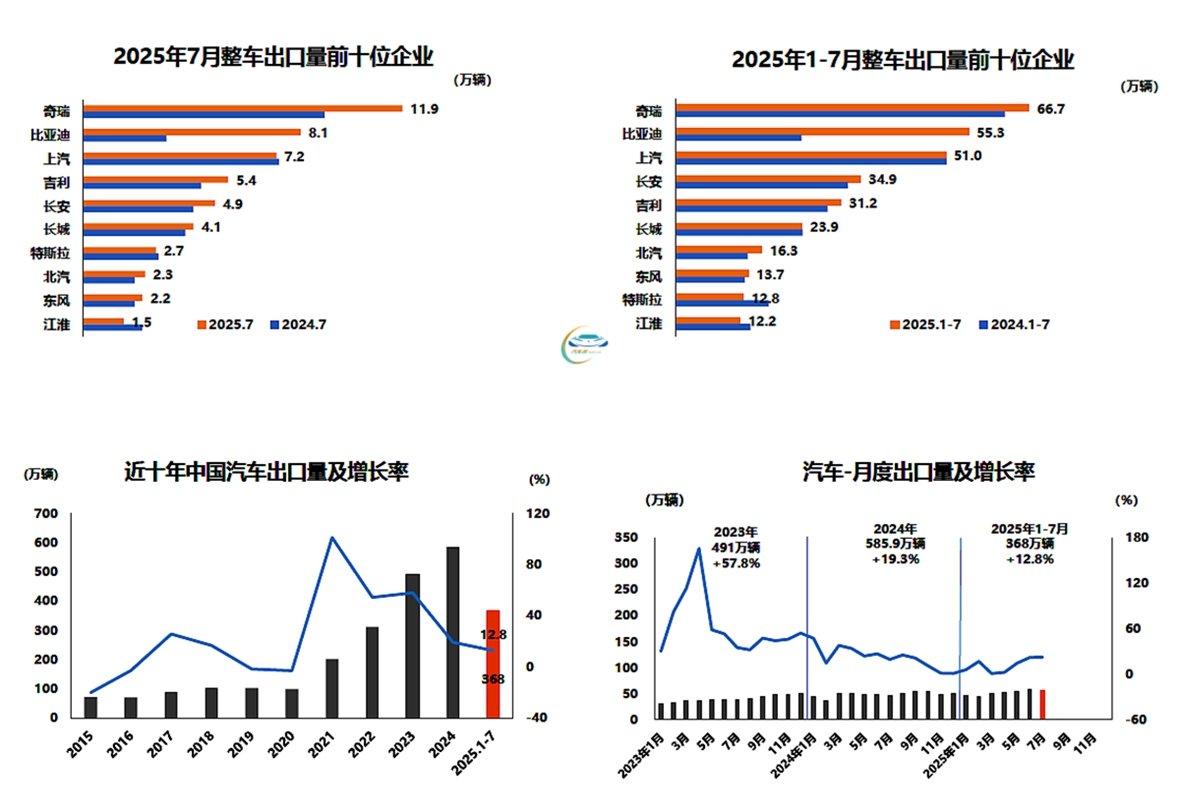
In overseas markets, new energy vehicles are also more popular. In July, new energy vehicle exports were 225,000 units, up 10% month-on-month and up 1.2 times year-on-year. Among them, new energy passenger vehicle exports were 220,000 units, up 11.9% month-on-month and up 1.2 times year-on-year.
From January to July, new energy vehicle exports were 1.308 million units, up 84.6% year-on-year. Among them, new energy passenger vehicle exports were 1.254 million units, up 81.6% year-on-year. Within the new energy vehicle export data, plug-in hybrid vehicles performed even more impressively — July exports were 85,000 units, up 12.9% month-on-month and up 2.2 times year-on-year. From January to July, plug-in hybrid vehicle exports were 475,000 units, up 2.1 times year-on-year.
Author: Liu Ying LY