 Click the arrow to the "Blue Word" and follow us!!
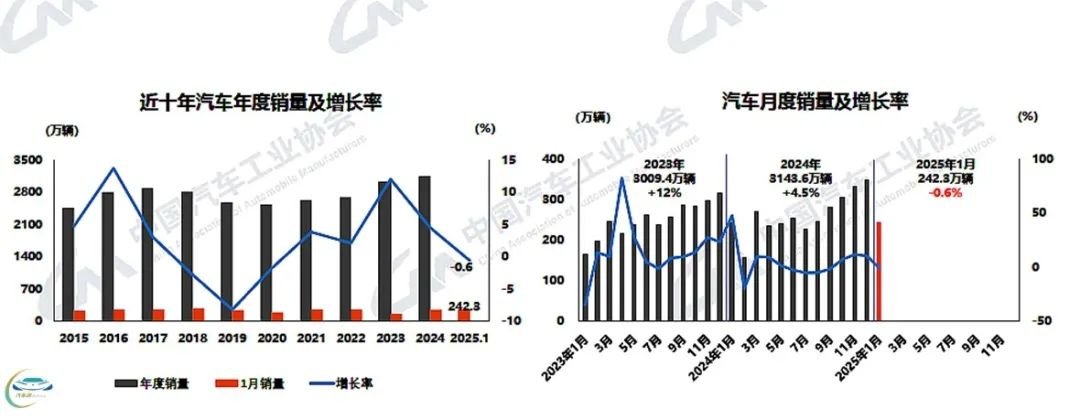
The "Spring Festival month" is traditionally a slow season for auto sales, but the start of 2025 performed differently. On February 17, the China Association of Automobile Manufacturers (CAAM) released auto market production and sales data for January 2025. According to the data, in January, auto production and sales reached 2.45 million and 2.423 million units respectively, down 27.2% and 30.5% month-on-month, with production up 1.7% year-on-year and sales down 0.6% year-on-year.
Compared with the "Spring Festival month" of 2024: last February, auto production and sales reached 1.506 million and 1.584 million units respectively, down 37.5% and 35.1% month-on-month and down 25.9% and 19.9% year-on-year. Even after accounting for February having three fewer days, the data comparison remains very striking. Accordingly, CAAM assessed the overall production and sales situation in 2025 as achieving a stable start.
From the perspective of those on the market front lines, January entered "Spring Festival time" near the latter part of the month, so actual effective working time exceeded half a month. In addition, automakers rolled out "open through the Spring Festival" initiatives. CAAM noted: "In 2025, consumption performance in major cities nationwide during the Spring Festival holiday rebounded significantly. During the holiday, average daily sales revenue in consumption-related industries nationwide grew by 10.8%."
Of course, the core driving force was: in January, despite fewer effective working days, driven by favorable factors such as the "trade-in" policy and the Spring Festival economy, auto production achieved slight growth and sales only edged down compared with the same period, bringing the industry a stable start. Among them, passenger vehicles continued their good performance, with production and sales both increasing year-on-year; new energy vehicle production and sales and auto exports continued their good performance.
Moreover, this year's policy implementation was highly efficient. CAAM also noted that before the holiday, the Central Economic Work Conference systematically deployed the 2025 economic work, and the more proactive and effective policy tone provided impetus for sustained economic recovery and improvement, helping boost market confidence and expectations. After the Spring Festival, the first State Council executive meeting clearly placed boosting consumption in a more prominent position, and relevant national ministries and commissions actively implemented the central deployment. "We believe that as a series of policies are introduced, implemented, and deepened, they will help the auto industry develop steadily and achieve a good start."
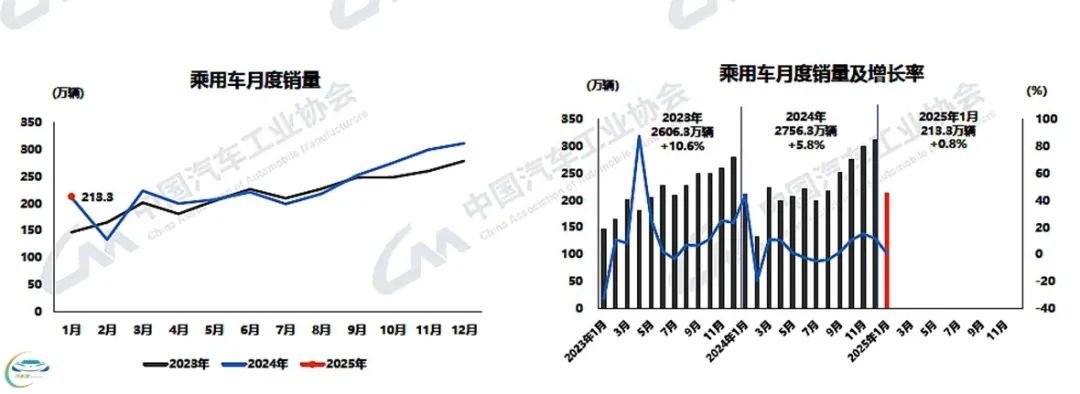
The main driving force of the auto market—passenger vehicle production and sales—completed 2.151 million and 2.133 million units in January respectively, down 28.4% and 31.6% month-on-month and up 3.3% and 0.8% year-on-year. Judging by the year-on-year data alone, last January had not yet entered the Spring Festival month, and achieving year-on-year growth with more than half a month of effective working days shows that this year's market momentum is indeed quite good.
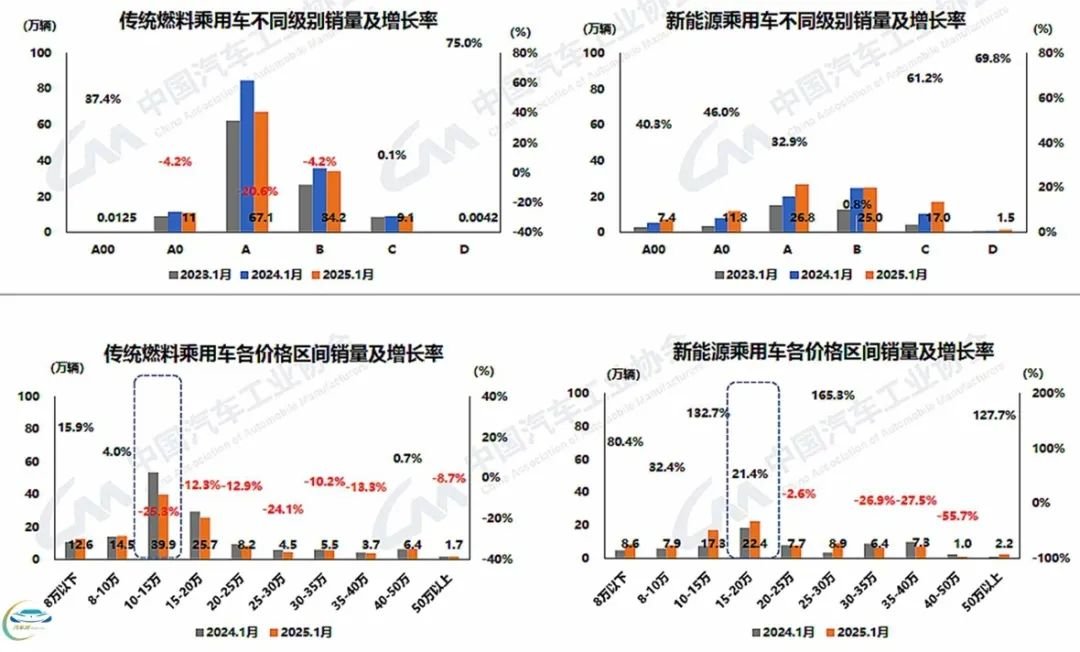
Among passenger vehicles, sales of traditional fuel passenger vehicles continued to decline to varying degrees, while new energy vehicles continued to grow. Previously, the editor believed that the current auto market is a process in which new energy vehicles are gradually replacing traditional fuel vehicles. Therefore, as this process extends, new energy penetration has become very obvious in A-segment and B-segment vehicles, which account for the mainstream of private consumption: in January, new energy passenger vehicles in all segments grew to varying degrees, with sales still mainly concentrated in A and B segments, with cumulative sales of 268,000 and 250,000 units respectively, up 32.9% and 0.8% year-on-year. Moreover, "the electrification trend in the B segment is obvious, and electrification in the C and D segments is leading consumption upgrading. Chinese high-end new energy brands continue to develop rapidly, driving a substantial increase in the share of high-end brand new energy passenger vehicles."
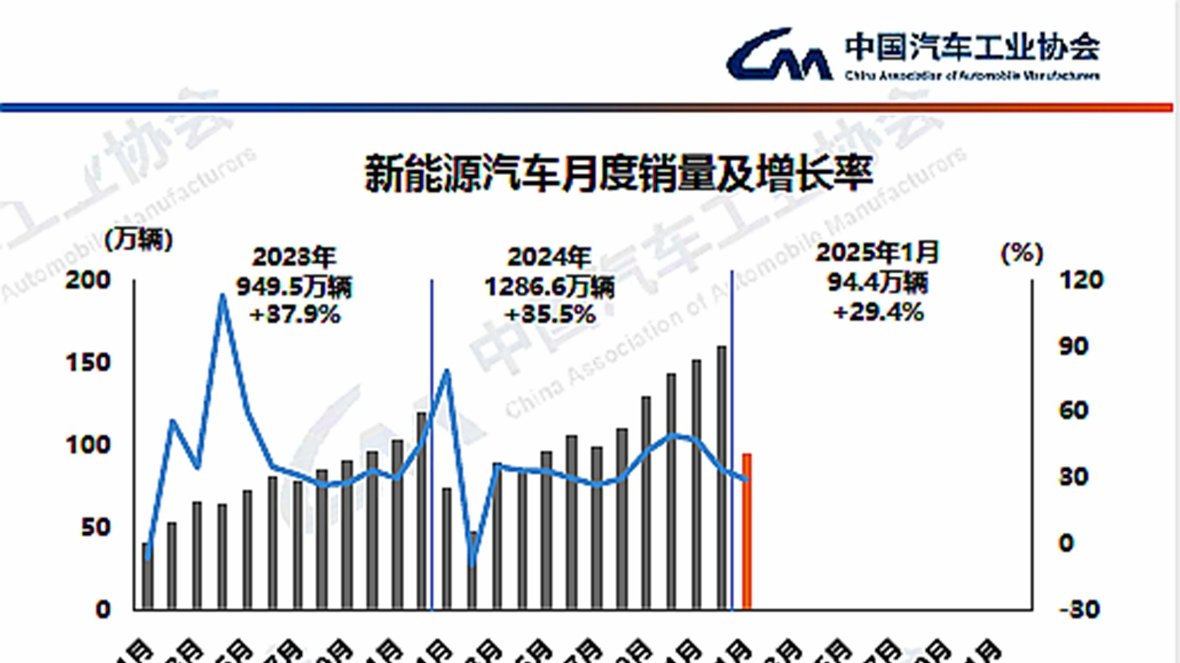
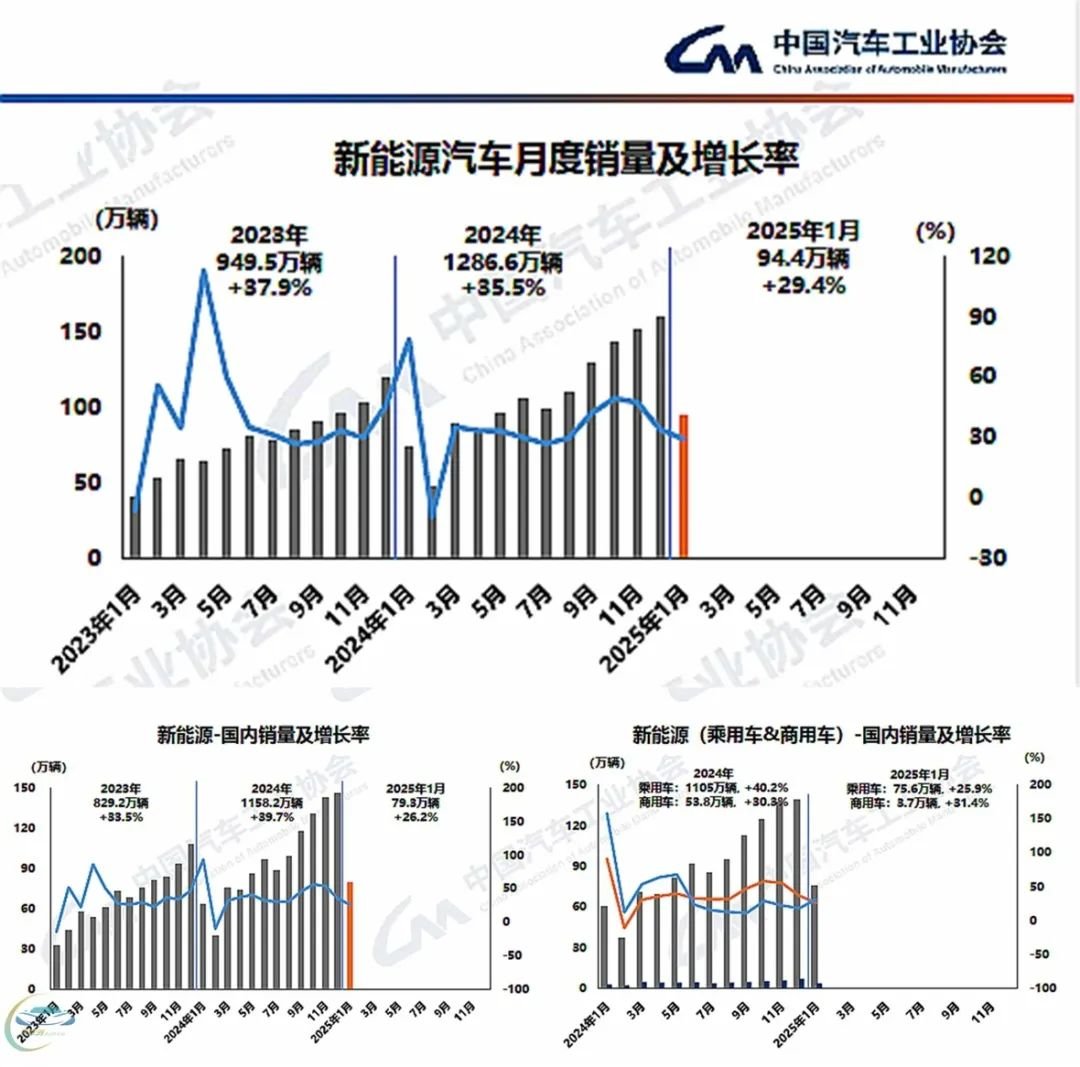
Further breaking down the new energy vehicle market: in January, new energy vehicle production and sales reached 1.015 million and 944,000 units respectively, up 29% and 29.4% year-on-year, and new energy vehicle sales reached 38.9% of total new vehicle sales.
Among the three major types of new energy passenger vehicles, battery electric vehicle growth accelerated in January, nearly matching the growth of plug-in hybrid electric vehicles, which had previously been growing at around 80%: in January, battery electric vehicle sales were 574,000 units, with a year-on-year increase of 29.1%, while plug-in hybrid electric vehicle sales were 370,000 units, with a year-on-year increase of 30%.
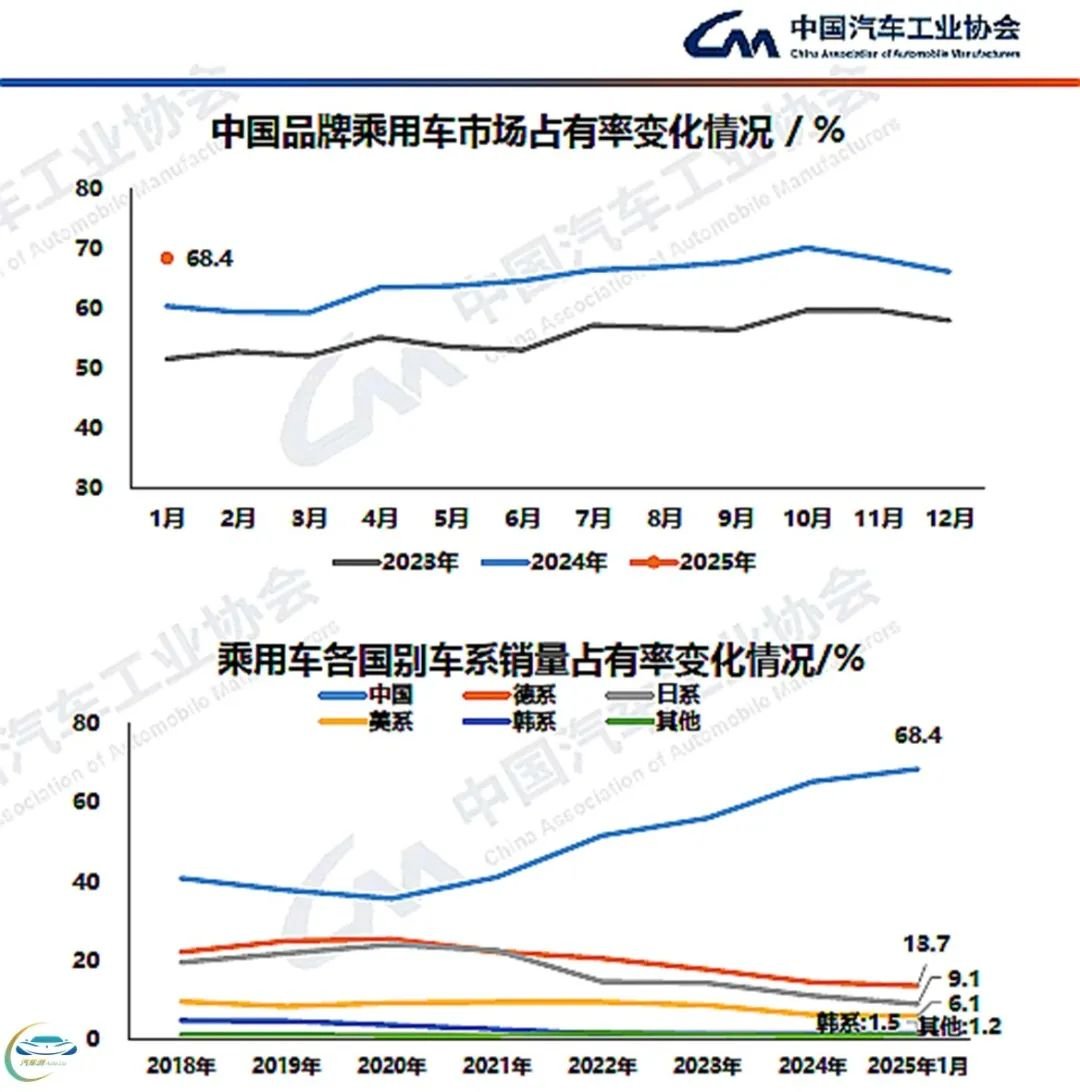
The growth in new energy passenger vehicle sales kept pace with the rising market share of Chinese brands, the main force driving new energy vehicles. In January, Chinese brand passenger vehicle sales reached 1.459 million units, up 14.1% year-on-year, with a sales share of 68.4%, up 8 percentage points from the same period last year.
Looking at the situation by country-specific vehicle series, under the premise that the market share of Chinese brands has been rising step by step, sales of other major vehicle series remain in decline. Of course, this situation also reflects from the side that the current market is a "stock market," with total volume growth not particularly obvious.
Compared with last year, the production and sales data released by CAAM for the first time this year added content on "vehicle imports." From the data itself, auto imports and exports performed like "ice and fire." According to data compiled by CAAM from the General Administration of Customs: in 2024, vehicle imports were 705,000 units, down 11.8% year-on-year; vehicle exports were 6.407 million units, up 22.7% year-on-year.
In December 2024, vehicle imports were 68,000 units, up 12.4% month-on-month and down 15.4% year-on-year; exports were 574,000 units, up 4.6% month-on-month and up 24.9% year-on-year.
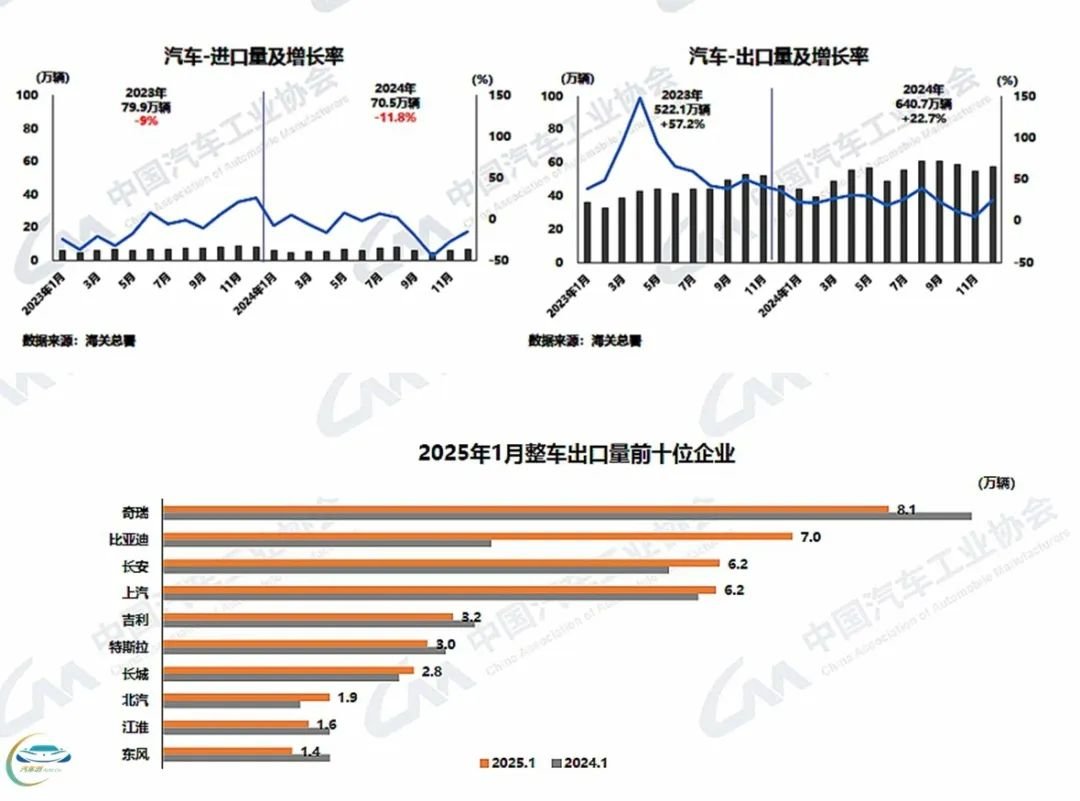
Among the top ten groups by complete vehicle exports, in January, Chery's export volume reached 81,000 units, down 10.3% year-on-year, accounting for 17.2% of total exports and maintaining its leading position; BYD and Changan grew significantly, with BYD exports reaching 70,000 units, up 91.5% year-on-year, ranking second, while Changan's export volume reached 62,000 units, tied with SAIC for third.
Author: Liu Jungang